JACK AND JILL MODEL OF CARE
Jack and Jill Children’s Foundation is a nationwide charity providing in-home nursing care and respite support for children up to the age of 7 with severe to profound neurodevelopmental delay.
Jack and Jill Children’s Foundation is a nationwide charity providing in-home nursing care and respite support for children up to the age of 7 with severe to profound neurodevelopmental delay.

May include brain injury, genetic diagnosis, cerebral palsy, and undiagnosed conditions. Another key part of the service is end-of-life care for children up to the age of six, irrespective of diagnosis. The initial blueprint and ethos of family-centred care continue to be the foundation for the service provision. Families refer to the practical service as ‘The Gift of Time’ – time to do the ordinary things that others take for granted. Jack and Jill Children’s Foundation use a criteria for referral based on the ACT categories:

“Life-threatening conditions which curative treatment may be feasible but can fail eg. cancer, irreversible organ failures of heart, liver, kidney”
Jack and Jill Children’s Foundation offer a service to children at end-of-life in this category within the age criteria.

“conditions when premature death is inevitable, where there may be long periods of intensive treatment aimed at prolonging life. Eg. cystic fibrosis, muscular dystrophy”
Generally, Jack and Jill Children’s Foundation do not provide a service to children/families within this category.

“progressive conditions without curative treatment options, where treatment is exclusively palliative and may commonly extend over many years. eg. Batten disease, mucopolysaccharidoses”
Jack and Jill Children’s Foundation commonly offer a service to children within this category.

“Irreversible but non-progressive conditions causing severe disability leading to susceptibility to health complications and likelihood of premature death. eg. severe cerebral palsy, multiple disabilities following a brain insult or complex health care needs and a high risk of an unpredictable life-threatening event or episode.”
Jack and Jill Children’s Foundation provide a service to children within this category who have a severe neurodevelopmental delay resulting in significant learning difficulties.
Additional criteria: Jack and Jill Children’s Foundation offer a service to children with Down syndrome who have two additional nursing needs, i.e. enteral feeding, oxygen therapy, non-invasive ventilation, seizure management, colostomy care and/ or bowel washouts and children with Down syndrome who come under category 4.

Respite support is offered to children up to the age of 7 who have severe neurodevelopmental delay. Another key part of our service is end of life care for all children up to the age of 7, irrespective of diagnosis.
*A family enquiry form, can be completed by a parent/guardian regarding eligibility.

A referral form must be completed. It is available to download or fill in online at www.jackandjill.ie/referral-form/. To request a copy by post, simply email [email protected]. Please include a medical report/ discharge summary when available.

When a referral is received the Liaison Nurse Manager (LNM) in the local area will contact the family as soon as possible.

The LNM will arrange a home visit and assess the child and family’s needs. They will explain the service, offer advice and practical support. Our service is flexible, and family centred.

We provide an average of 20-40 in home nursing/respite hours per month (maximum 80 hours). The LNM's role includes ongoing support, co-ordinating respite, home visits and advocacy. The LNM will liaise with other health professionals as required.

Timely provision of in-home nursing care of 80 hours per month can be provided at end of life. The LNM’s will; assist in organising and support nurses; listen and help co-ordinate families wishes; regularly review the child and family’s needs; work together with other health care professional and service providers.
The role of the Liaison Nurse Manager is to offer support and advocate for the child and their family while facilitating an in-home respite service if the family choose to avail of it. Once a new referral has been received and the Liaison Nurse Manager meets the family, a case assessment is completed to determine what type and amount of support the family need. The case assessment includes the medical needs of the child, the practical needs of the child & family, and the psychosocial needs of the family unit. The needs of the child will dictate whether the family needs a Carer or a Nurse to help support them.
After this initial visit, the Liaison Nurse Manager may assist the family in finding a suitable carer or nurse (or more than one, depending on the hours required) who can fulfil the hours needed by the family. After an introduction to the family, the carer/nurse and the family work together to make a schedule for the Jack and Jill hours. The average number of hours per month is 20-40 but can be up to a maximum of 80 hours per month. When the child turns 5 years old, hours are reduced to 20 per month as a transition for the period of one year and then service stops when the child turns 6 years old. Respite hours are reviewed regularly and adjusted as needed according to the child and family’s needs.
The family receives a monthly donation to pay the carers/nurses directly. There are nurses and carers in every community across Ireland, who provide the in-home respite service for the families. The nurses and carers who provide respite hours come from a variety of backgrounds, personally and professionally, but all have the same focus of providing high quality, child-centred care to the family. They often become an important resource for the child and family and can remain with them for many years. Their professionalism and flexibility allow the service to continue along with the support of the Liaison Nurse Manager. The Liaison Nurse Manager visits, offers support, advocates, and helps coordinate care as needed.
They are also available to advise and guide the Nurses and Carers providing the respite hours. Jack and Jill Children’s Foundation recognise that caring for a child at home is a 24-hour-a-day commitment, and that children’s needs often become more acute outside of limited-service hours (Nicholl, 2012). For children nearing endof-life, the Liaison Nurse Manager can be contactable out-of-hours and over the weekend, when appropriate.
A Day in the Life of a Jack and Jill
Liaison Nurse Manager – June’s Story
In 2017, a “Service Evaluation of the Jack and Jill Children’s Foundation: Full Report” was published. Much valuable feedback was gathered about the service and support that the Jack and Jill Foundation provide to families. Families highlighted the support of the Liaison Nurse Manager during focus groups which follow:

Some children achieve positive developmental growth. When this occurs, a plan for withdrawal of service is put in place as they no longer meet our criteria.

Many children will ‘graduate’ from the service when they reach their 7th birthday.

For others, they may transition to end-of-life within their first six years due to a deterioration in their underlying condition or a sudden event such as a lifethreatening seizure or recurrent infections.

Sometimes the family meets the Liaison Nurse Manager for the first time when their child is close to the end of their life. The funding offered to families for in-home respite ceases when the child turns 7 years old. However, the Liaison Nurse Manager is available as an ongoing support.
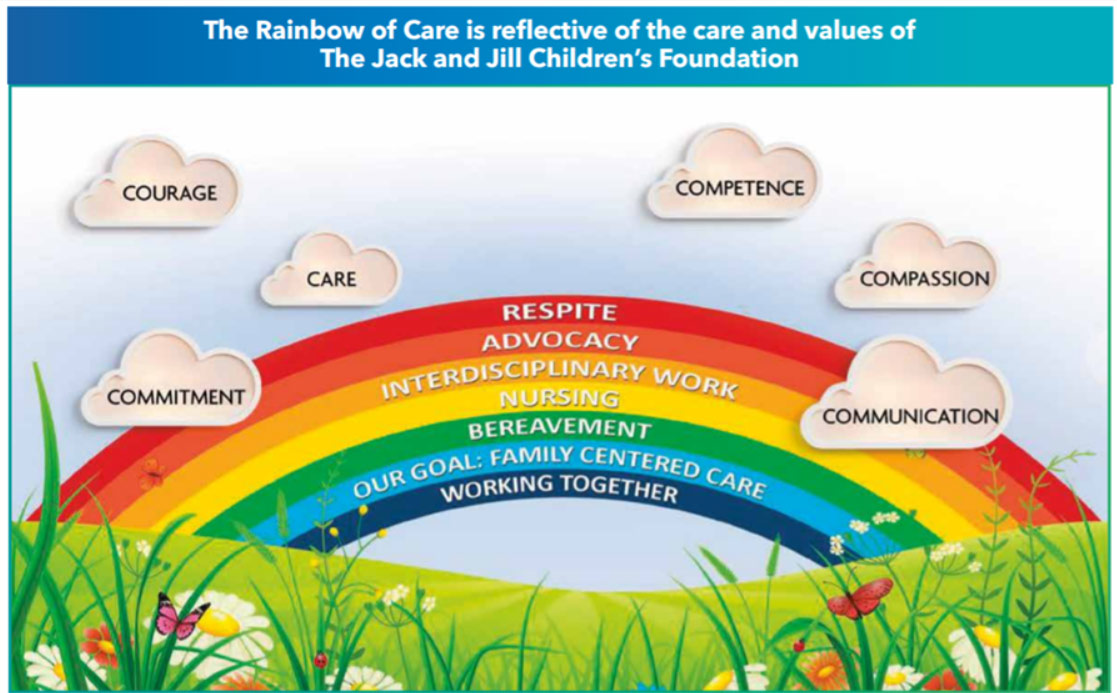
This model of care is underpinned by the paradigm of the Rainbow of Care*, which in turn is supported by six pillars (6 C’s) representing the core values. Jack and Jill Children’s Foundation is committed to providing compassionate and competent nursing care for children with complex needs and their families, using effective communication and courage to speak up for them and seek solutions to problems that may arise.
Respite care at home is provided to families with children up to the age of 7, with complex and/or palliative care needs. Direct funding is given to families to enable them to finance home respite care. Respite hours are facilitated by local nurses and/or carers.
The Liaison Nurse Manager listens and discusses with parents and families, what their needs and wishes are for their child. The Liaison Nurse Manager can advocate for entitlements, provide advice and information on how to access all the services the child may require. Empowering parents to manage their child’s care at home and supporting them in advocating for themselves is also part of the Liaison Nurse Manager’s role.
The Liaison Nurse Manager engages with a range of health and social care professionals to ensure that children and their families receive the best care and quality of life.
In-home respite care is coordinated by the Liaison Nurse Manager in their local area. Individualized nursing care and advice on how best to care for the child at home is fundamental.
The Liaison Nurse Manager provides bereavement support before and after the child’s death, and can inform families of additional resources that are available nationally. This is an important aspect of care for families whose children are at end-of-life and after their death. Continuing, ongoing support is offered after death, and is family-led based on their wishes.
Keeping the family at the centre of all information and decision-making, is the goal of Jack and Jill Children’s Foundation
The Liaison Nurse Manager works with families as a team through the trajectory of the child’s illness and walks alongside the parents and helps them navigate through the process and procedures. As part of the multidisciplinary team, the Liaison Nurse Manager attends meetings and shares relevant information with the rest of the healthcare team both in hospital and at home in the child’s community. *The Rainbow of Care was adapted by Doyle & Clay (cited in Coventry Report, 2017).
Phone: +353 45 894 538 or Email: [email protected]